

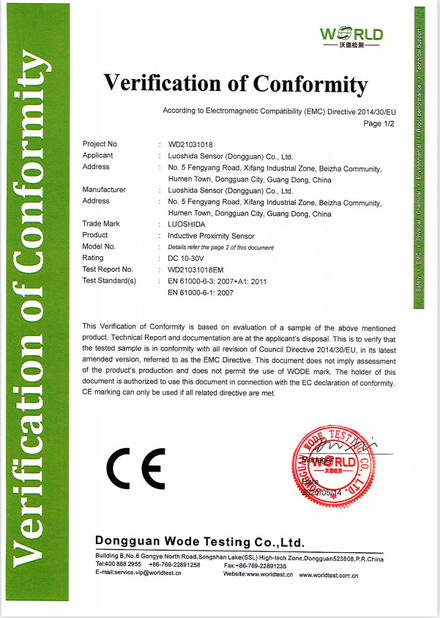
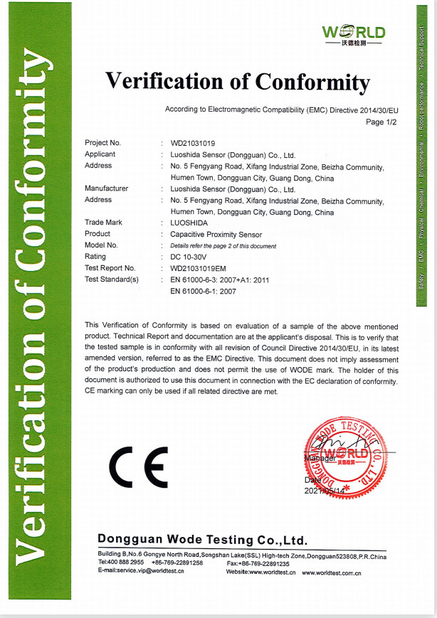

Rectangular inductive proximity sensors are emerging as a preferred option for high-frequency, high-precision metal detection in access-control gates, industrial machine tools and automated assembly lines. Their flat, compact geometry and sealed housings allow them to be embedded directly into machine frames and guide rails, where cylindrical models can be awkward to mount. The design is now widely specified for applications in which repeatability and resistance to harsh plant conditions matter more than raw sensing range.
The devices operate on the principle of electromagnetic induction. An oscillator circuit inside the sensor drives a coil in the sensing face, generating a high-frequency electromagnetic field that extends slightly beyond the housing. When a metal target enters that field, eddy currents form within the target and draw energy from the oscillator, reducing the amplitude of oscillation.
An internal evaluation circuit monitors the change continuously. Once the drop exceeds a preset threshold, the sensor switches its output, typically a PNP or NPN solid-state signal, to indicate the presence of the target. Because nothing physically touches the object being detected, the method avoids the wear associated with mechanical limit switches and supports reliable operation at high cycling rates.
Compared with conventional cylindrical sensors, rectangular inductive units offer structural benefits that matter in specific industrial settings.
Together, these characteristics make the rectangular format well suited to gate mechanisms and linear motion systems, where the sensor is often confined to a narrow cavity and the target passes at a fixed distance and angle.
Buyers evaluating rectangular inductive sensors generally compare a small set of parameters that determine whether a unit will survive the installation environment and interface correctly with the control system.
| Parameter | Typical reference |
|---|---|
| Output type | PNP or NPN solid-state switch |
| Ingress protection | IP67 / IP68 / IP69K |
| Housing material | Nickel-plated brass / stainless steel (V4A/AISI 316L) |
| Core characteristics | Non-contact sensing, electromagnetic immunity, resistance to vibration and shock |
Housing material and ingress rating are the most reliable indicators of endurance in demanding settings. Units built to IP69K and fitted with stainless steel bodies are intended for high-pressure washdown and repeated exposure to cleaning agents, while nickel-plated brass versions are generally used in drier machine-building applications.
اتصل شخص: Mrs. Anna
الهاتف :: 18925543310


 Arabic


