

logo
ส่งข้อความ
บ้าน

บล็อก เกี่ยวกับ Guide to Proximity Sensors Principles and Applications

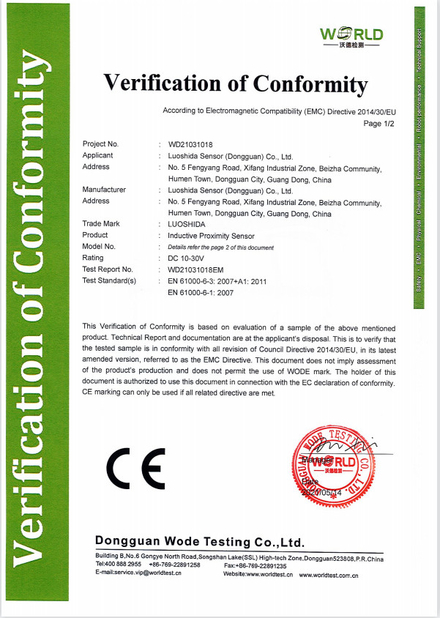
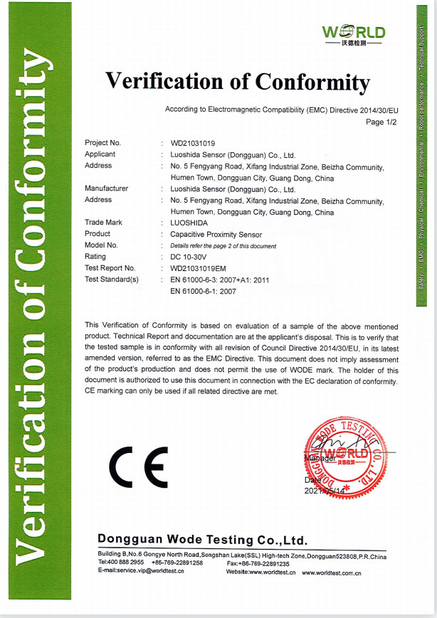
ได้รับการรับรอง
จีน Luo Shida Sensor (Dongguan) Co., Ltd. รับรอง
สนทนาออนไลน์ตอนนี้ฉัน
บริษัท บล็อก
Guide to Proximity Sensors Principles and Applications
ข่าว บริษัท ล่าสุดเกี่ยวกับ Guide to Proximity Sensors Principles and Applications

Imagine a world where devices sense your presence without physical contact, automatically activating or performing specific operations. This isn’t science fiction—it’s the reality enabled by proximity sensors. From smartphones that dim screens when held to the ear to precision positioning in industrial automation lines, these sensors are quietly transforming how we live and work.

This article delves into the types, working principles, and real-world applications of proximity sensors, offering a comprehensive guide to help you select the right technology for your projects.

Proximity Sensors: The Cutting Edge of Non-Contact Detection

Proximity sensors detect nearby objects without physical contact. Compared to traditional contact-based sensors, they offer significant advantages: no wear and tear, faster response times, higher reliability, and non-invasive operation. These benefits make them indispensable in industrial automation, consumer electronics, automotive systems, and beyond.

Three primary types dominate the market: capacitive, inductive, and magnetic proximity sensors, each with distinct operating principles and applications.

Three Major Proximity Sensor Types: How They Work
1. Capacitive Sensors

Working Principle: These sensors detect changes in capacitance between the sensor and a target object. The sensor and object form a capacitor; as the object approaches, capacitance changes trigger detection.

Key Features: Cost-effective, durable, and adaptable to various environments. Can detect both metallic and non-metallic objects. Limited detection range and susceptible to humidity/temperature fluctuations.

Applications: Touchscreens, liquid level detection, proximity switches.

2. Inductive Sensors

Working Principle: Uses high-frequency oscillation circuits. When metal objects approach, they absorb energy, reducing oscillation amplitude—this change signals detection.

Key Features: Longer detection ranges and strong interference resistance. Only detects metal objects. Higher power consumption and cost.

Applications: Metal detection, position sensing, safety systems.

3. Magnetic Sensors

These use magnetic field variations and come in two subtypes:

Reed Switch Type:

  • Working Principle: Physical switches activated by magnets. Magnetic force closes contacts; spring reopens them when magnet retreats.
  • Key Features: Simple, low-cost, reliable. Short detection range and slower response.
  • Applications: Door sensors, limit switches.

Hall Effect Type:

  • Working Principle: Measures voltage changes (Hall voltage) from magnetic fields affecting current-carrying conductors.
  • Key Features: High precision, fast response, detects weak fields. Sensitive to temperature/EM interference.
  • Applications: Angle/current/position sensing.
Selecting the Right Proximity Sensor

Consider these factors when choosing:

  • Detection Range: Match to your operational needs.
  • Target Material: Sensor compatibility with object composition.
  • Environment: Temperature, humidity, and EMI conditions.
  • Precision: Required accuracy level.
  • Cost: Balance performance with budget.
  • Response Speed: Time-critical applications demand faster sensors.
The Future of Proximity Sensing

Advancements will focus on:

  • Miniaturization: Smaller components enabling compact designs.
  • Smart Integration: Advanced algorithms for enhanced detection and control.
  • Wireless Connectivity: Remote monitoring capabilities.
  • Multifunctionality: Combined sensing features for comprehensive data collection.

As a cornerstone of modern sensing technology, proximity sensors will continue expanding their role across industries. Understanding their capabilities ensures optimal implementation for smarter, more efficient systems.

ผับเวลา : 2026-06-02 00:00:00 >> blog list
รายละเอียดการติดต่อ
Luo Shida Sensor (Dongguan) Co., Ltd.

ผู้ติดต่อ: Mrs. Anna

โทร: 18925543310

ส่งคำถามของคุณกับเราโดยตรง (0 / 3000)