

logo
Mesaj gönder
Ana sayfa

blog Hakkında Luoshida M5 Inductive Proximity Sensor Targets Industrial Precision

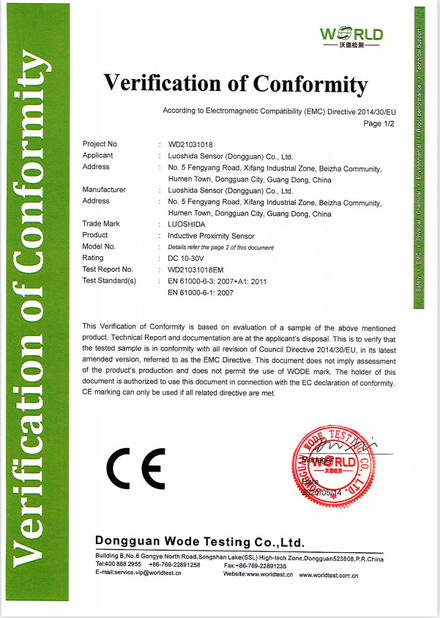
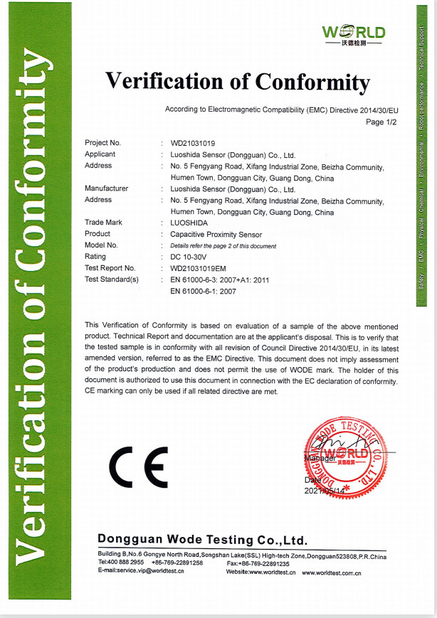
Sertifika
Çin Luo Shida Sensor (Dongguan) Co., Ltd. Sertifikalar
Ben sohbet şimdi
şirket blog
Luoshida M5 Inductive Proximity Sensor Targets Industrial Precision
hakkında en son şirket haberleri Luoshida M5 Inductive Proximity Sensor Targets Industrial Precision

Industrial automation systems depend on compact sensing components that operate continuously and often out of sight. The Luoshida Flush M5, model I1s050.8no, is one such inductive proximity sensor, designed to collect switching data in high-cycle production environments. Though small in size, its performance can directly affect response efficiency and safety redundancy on automated equipment.

Core specifications and selection logic

The sensor’s model designation encodes several key selection parameters, making it easier for maintenance and spare-parts teams to identify the correct component. The unit uses an M5 threaded housing and is configured for flush mounting with a normally open output.

Parameter Specification
Model Luoshida I1s050.8no
Housing diameter M5 (5mm)
Sensing distance 5mm
Mounting type Flush
Output mode NO (normally open)

From a data-analysis perspective, understanding these specifications is essential for optimizing equipment maintenance and spare-parts management. The 5mm sensing distance and 5mm housing diameter place the unit in the compact end of the industrial sensor market.

Operating principle and physical characteristics

The sensor operates on electromagnetic induction. An internal oscillator circuit generates an alternating magnetic field; when a metal object enters that field, eddy currents form on the object’s surface, changing the impedance of the oscillator circuit and triggering a switch signal.

This non-contact detection method offers several engineering advantages:

  • Long service life: Because there is no physical contact, the design avoids mechanical wear and extends service life on high-speed production lines.
  • Environmental adaptability: The flush-mount design provides better physical protection and uses shielding effects to reduce electromagnetic interference from nearby metal components, helping ensure stable signal output.
  • Compact footprint: The M5 miniature design allows the sensor to be embedded in precision machine tools or small assembly lines where space is limited.

Performance in industrial applications

In automated control logic, the sensor is mainly used for three functions:

1. Precise positioning and sequence control

During robotic pick-and-place tasks, the sensor detects component positions to keep production flow synchronized and reduce downtime caused by position errors.

2. Production counting and inventory monitoring

By counting metal workpieces at regular intervals, the system can generate real-time production data and provide basic data support for inventory management and quality control.

3. Safety limit monitoring

As part of a safety logic circuit, the sensor can monitor machine travel limits and help prevent equipment collisions caused by mechanical overtravel.

Frequently Asked Questions

What is the difference between flush and non-flush mounting when selecting a sensor?
Flush mounting allows the sensor’s sensing face to sit level with the mounting surface, making it suitable for applications with strict space requirements and a need to shield against nearby environmental interference. Non-flush mounting usually offers a longer sensing distance, but because the sensing field is more exposed, it places greater demands on metal shielding in the installation environment.
How can I determine whether this sensor is compatible with my control system?
The control system’s input voltage level, load current limit, and support for normally open (NO) logic must be verified. This model is normally open, meaning the circuit is open when no metal is detected and closed when metal is detected.
Is the sensor reliable in humid or oily industrial environments?
Inductive sensors have strong resistance to interference from non-metallic media such as oil and dust, but installation should ensure that the connector’s protection rating meets the requirements of the site environment. If corrosive liquids are present, the housing material should be checked against chemical resistance standards.
Pub Zaman : 2026-10-24 00:00:00 >> blog list
İletişim bilgileri
Luo Shida Sensor (Dongguan) Co., Ltd.

İlgili kişi: Mrs. Anna

Tel: 18925543310

Sorgunuzu doğrudan bize gönderin (0 / 3000)