

logo
문자 보내

블로그 약 Guide to Proximity Sensor Principles and Optimization

인증
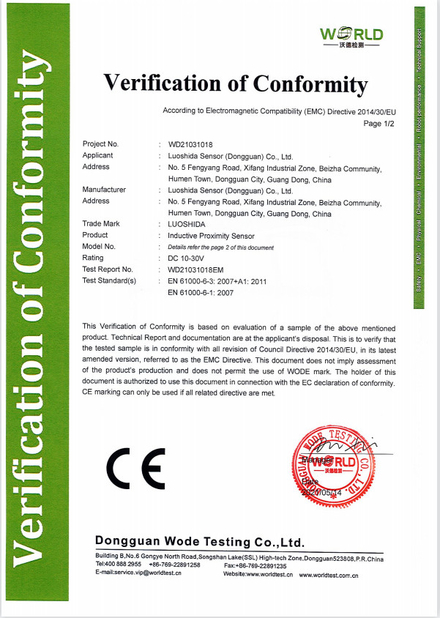
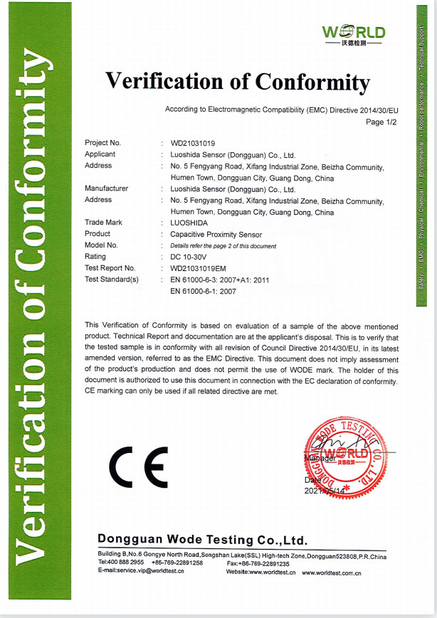
중국 Luo Shida Sensor (Dongguan) Co., Ltd. 인증
제가 지금 온라인 채팅 해요
회사 블로그
Guide to Proximity Sensor Principles and Optimization
에 대한 최신 회사 뉴스 Guide to Proximity Sensor Principles and Optimization

Imagine a highly automated production line where robotic arms precisely grasp components, all orchestrated by an unsung hero - the proximity sensor. Acting as the "eyes" of the manufacturing process, these remarkable devices detect object presence without physical contact, ensuring flawless execution at every stage. But how exactly do these technological marvels function, and what considerations guide their selection and application?

1. Proximity Sensors: The Power of Non-Contact Detection

Proximity sensors represent a class of non-contact object detection devices. Unlike photoelectric sensors that require light, proximity sensors primarily operate on electromagnetic induction principles, detecting changes in electromagnetic fields caused by approaching objects. This makes them insensitive to ambient light conditions and particularly suitable for harsh industrial environments with dust, oil, or other contaminants. However, it's important to note that traditional inductive proximity sensors can only detect metallic objects.

2. Working Principle: The Elegance of Electromagnetic Induction

High-frequency inductive proximity sensors center around their LC oscillator circuit, which generates a high-frequency electromagnetic field radiating from the sensor's detection face. When a metal object approaches, two scenarios occur:

  • Non-magnetic metals: Generate eddy currents that consume oscillator circuit energy, weakening oscillations.
  • Magnetic metals: Create both eddy currents and hysteresis losses, significantly reducing or stopping oscillations.

The sensor's internal evaluation unit monitors these amplitude changes, converting them into switch signals for controlling external devices like PLCs or relays. Industry terminology describes these states as "damped" (metal detected) and "undamped" (no metal present).

3. Critical Parameters: Decoding Specifications for Optimal Selection

Selecting the right proximity sensor requires careful consideration of these key parameters:

  • Nominal sensing distance (Sn): Maximum detection range for standard metal plates.
  • Effective operating distance (Su): Practical range accounting for temperature and voltage fluctuations (typically 0.9Sr-1.1Sr).
  • Operating distance (Sa): Reliable triggering distance under specified conditions (usually 0%-81% of Sn).
  • Output configuration: NO (normally open) or NC (normally closed) switching functions.
  • Electrical characteristics: Includes relay current (Ia), minimum load current, operating voltage range (Vb), and peak current (Ir).
  • Performance metrics: Switching frequency, response time after power-on (tv), and environmental tolerance.
4. Installation & Application: Where Precision Meets Practice

Optimal sensor performance hinges on proper implementation:

  • Approach orientation: Axial approach provides maximum detection range; lateral approach significantly reduces sensitivity.
  • Metallic interference: Nearby metal surfaces may impair performance, requiring specialized mounts or positioning adjustments.
  • Multi-sensor coordination: Staggered placement or shielding prevents interference in dense installations.
  • Environmental protection: While rugged, sensors benefit from appropriate IP ratings (e.g., IP67) in extreme conditions.
5. Selection Strategy: Matching Technology to Need

A methodical selection process considers:

  • Target composition: Differentiating between magnetic and non-magnetic metals.
  • Range requirements: Balancing detection distance against potential false triggers.
  • Spatial constraints: Compact designs for confined spaces.
  • Electrical compatibility: Aligning output types (NPN/PNP) and voltage with control systems.
6. Real-World Applications: Industrial Problem-Solving

Proximity sensors enable diverse automation solutions:

  • Production counting: Automated inventory tracking on conveyor lines.
  • Robotic positioning: Ensuring mechanical arm movement accuracy.
  • Safety systems: Preventing operator injury in hazardous machinery zones.
  • Access control: Triggering automatic door mechanisms.
7. Future Horizons: Intelligent Integration

Advancements point toward smarter, more connected sensors featuring:

  • Enhanced precision and noise immunity
  • Wireless connectivity for cloud-based monitoring
  • Self-diagnostic capabilities for predictive maintenance

As industrial automation evolves, proximity sensors will continue playing a pivotal role in optimizing efficiency, reducing costs, and enabling increasingly sophisticated control systems. Understanding their technical nuances empowers engineers to harness their full potential in the smart factories of tomorrow.

선술집 시간 : 2026-04-27 00:00:00 >> blog list
연락처 세부 사항
Luo Shida Sensor (Dongguan) Co., Ltd.

담당자: Mrs. Anna

전화 번호: 18925543310

회사에 직접 문의 보내기 (0 / 3000)